Flyer Printing in Kenya: How to Choose Sizes, Paper and a Design That Gets Enquiries
A customer should not have to study your flyer to understand what you are offering. Whether you are promoting a shop opening, advertising a service or inviting people to an event, the message needs to be clear within a quick glance.
Before you print, decide who will receive the flyer, what matters to them and what you want them to do next. Those decisions should guide the size, paper, design and quantity.
This guide to flyer printing in Kenya will help you prepare an order that suits your campaign—and avoid spending money on a stack of flyers without a distribution plan.
Start with One Clear Purpose
A flyer works best when it has a specific job.
You might want customers to visit a new shop, enquire about a service, attend an event or redeem an offer. Choose the main action before writing the headline or selecting photographs.
For example, a salon promoting a new branch could prioritise its location, opening offer and booking number. A company advertising office cleaning might focus on the service area, what the package covers and how to request a quotation.
Both need a clear message, but they need different content.
Before preparing your design, write down:
- Who the flyer is for.
- The product, service or event being promoted.
- The main reason someone should be interested.
- The action they should take.
- Where and how the flyer will reach them.
Explore our business flyers printing services in Kenya once you have your message and distribution plan in mind.
Which Flyer Size Should You Choose?
Choose the size around the content and how the flyer will be distributed. More space is useful only when you have relevant information to fill it.
A compact flyer may suit a straightforward offer handed to potential customers. A larger format gives you more room for service details, product images or event information.
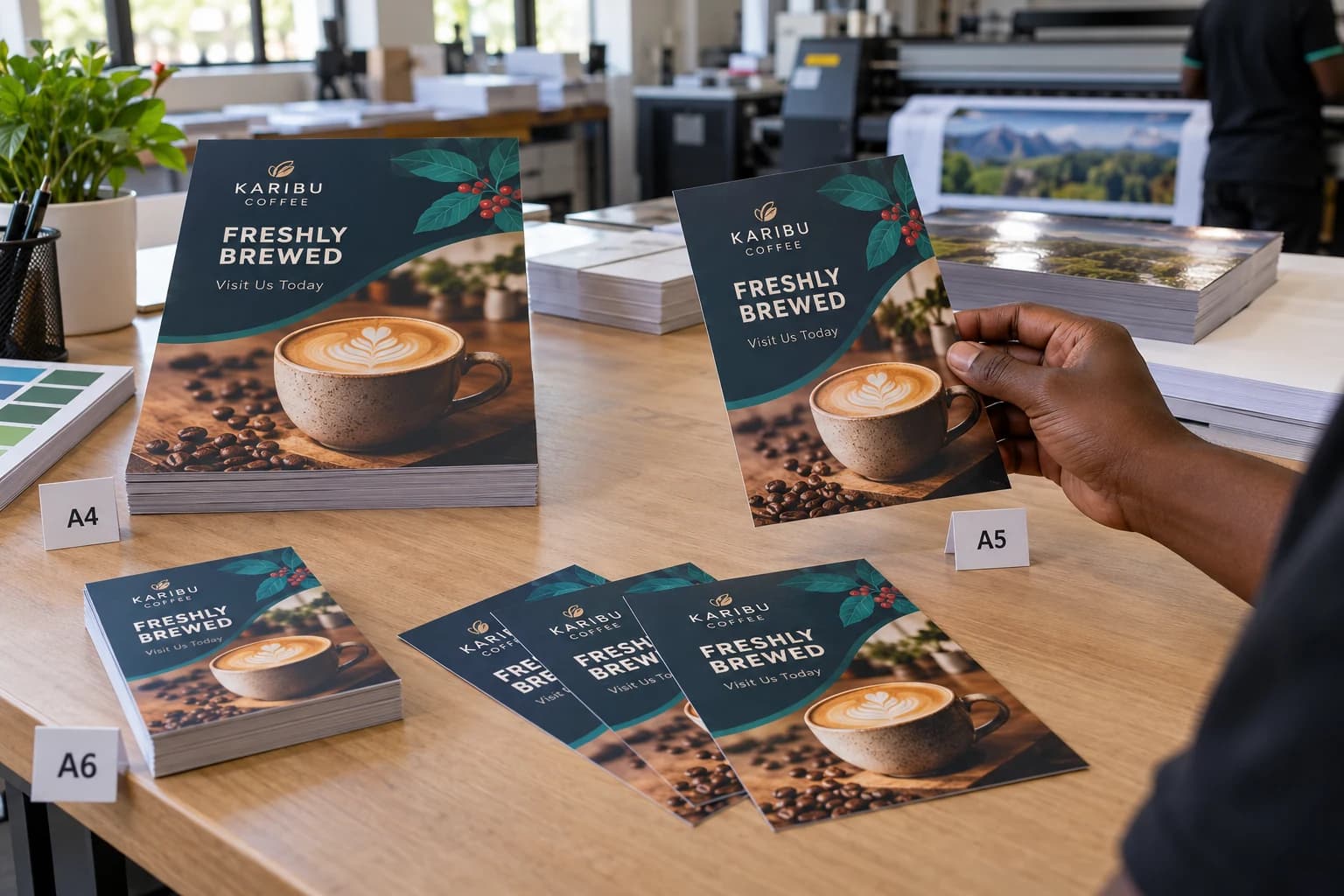
| Size | Dimensions | When to consider it |
|---|---|---|
| A6 | 105 × 148 mm | A short offer, invitation or compact handout |
| A5 | 148 × 210 mm | A promotion that needs room for images and supporting details |
| A4 | 210 × 297 mm | A detailed information sheet, menu or service overview |
These are standard A-series dimensions. Confirm the finished size and available printing options before preparing the artwork.
Avoid shrinking a detailed A4 layout to A6 without redesigning it. The text may become difficult to read, and the main message can lose its prominence.
Single-Sided or Double-Sided?
Single-sided printing can suit a brief announcement or a simple promotional offer.
Double-sided printing gives you space to separate the main message from supporting information. You could place the headline and offer on the front, then explain the service, location and contact details on the back.
Make the front useful on its own. Some recipients may not turn the flyer over immediately.
How to Choose Paper for Flyers
Paper affects the feel of the flyer, the appearance of the print and the overall cost.
Paper weight is commonly expressed in grams per square metre, or GSM. A higher GSM generally means heavier paper, although thickness and stiffness also depend on the stock.
Ask to see available samples. Consider how the flyer will be handled, whether it needs to be folded and how long you expect someone to keep it.
For a brief promotional handout, you may prioritise an economical stock suitable for your distribution quantity. For a presentation or service introduction that customers are expected to keep, a more substantial paper may be worth discussing.
There is no single paper weight that is right for every campaign. Confirm the exact stock with your printer rather than relying only on descriptions such as “standard” or “premium.”
Matte or Gloss: Which Finish Suits Your Design?
The surface finish changes how your flyer looks and feels.
A gloss surface reflects more light and can give photographs and colour blocks a vivid appearance. A matte surface has a more subdued look with less reflection.
Ask whether the quoted finish refers to the paper surface, an added coating or lamination. These are different specifications and can affect the price.
If you plan to write appointment details, names or reference numbers on the flyer, test the proposed paper and finish with your preferred pen.
For folded flyers, also confirm whether the selected stock needs creasing to achieve a neat result.
What Should You Put on a Business Flyer?
Give each part of the design a clear role. The headline attracts attention, the supporting details explain the offer, and the call to action tells the reader what to do.
A Headline That Explains the Offer
Lead with something the intended customer can understand quickly.
“New Branch Now Open in Westlands” communicates a clear announcement. “Book Office Cleaning for Your Business” tells readers what service is available.
A company name can be prominent, but an unfamiliar name alone may not explain why someone should keep reading.
Relevant Images
Use photographs that represent the actual product, service or experience.
Keep them sharp enough for the intended print size. A small image copied from social media may look unclear when enlarged.
Choose a few useful images rather than filling every gap. Leave space for the headline, offer and contact details.
Useful Supporting Details
Include the information a reader needs to decide whether to enquire.
Depending on the campaign, this could be:
- What the service includes.
- The product or package being promoted.
- The location or delivery area.
- The event date and venue.
- The offer price and relevant conditions.
- The booking or enquiry process.
If an offer has an expiry date or quantity restriction, make it clear.
One Main Call to Action
Choose a direct next step, such as:
- Call to request a quotation.
- WhatsApp to book.
- Visit the shop.
- Scan to view the product range.
- Register for the event.
You can provide more than one contact method, but keep the main action easy to identify.
Keep the Layout Readable
A flyer does not need to use every available centimetre.
Leave enough space between sections and use a clear reading order. The headline should stand out first, followed by the offer, supporting details and next step.
Use strong contrast between text and background. Avoid placing small contact details over a busy photograph.
Review the artwork at its actual print size. A layout that looks clear when enlarged on a laptop may be difficult to read on an A6 flyer.
Your printer can confirm the required bleed and safe margins. Background artwork that reaches the edge may need to extend beyond the final cut line, while important text should remain safely inside it.
How Many Flyers Should You Print?
Start with the distribution plan, then choose the quantity.
Estimate how many relevant people you can realistically reach, where you will distribute the flyers and how long the campaign will run.
For a new campaign, a smaller test can help you assess the message and distribution method before committing to a larger order.
Consider:
| Distribution method | What to plan |
|---|---|
| Handouts near your business | Suitable locations, permission where needed and staff availability |
| Exhibition or event distribution | Expected relevant visitors and the number of days |
| Flyers inside customer orders | Typical order volume during the campaign |
| Partner business displays | Permission, display space and replenishment |
| Branch distribution | Quantity required at each location |
A lower printing cost per flyer does not automatically mean better value. Unused flyers with expired offers or outdated contact details still represent wasted spend.
What Affects Flyer Printing Prices in Kenya?
The final price depends on the specifications and work included.
Common factors are:
- Finished size.
- Quantity.
- Paper type and weight.
- Single-sided or double-sided printing.
- Folding or other finishing.
- Artwork preparation.
- Delivery and applicable taxes.
Ask for a quotation using clear specifications. For example, state the size, quantity, preferred paper and whether both sides will be printed.
Confirm whether design and finishing are included. Comparing quotations is easier when they cover the same requirements.
How to Track Enquiries from Your Flyers
You need a way to distinguish flyer enquiries from other enquiries.
One option is a short campaign code that customers mention when calling, messaging or visiting your shop. Another is a QR code leading to a dedicated enquiry page.
If you use a QR code:
- Test it at the final printed size.
- Keep clear space around it.
- Use strong contrast.
- Check that the destination works on mobile.
- Explain what the reader will find after scanning.
Keep a visible telephone number or other contact option alongside it.
Record the number of flyers distributed, enquiries received and resulting orders. QR scans show interaction, but they do not tell you how many people purchased. Follow the enquiry through to the outcome.
When Should You Use a Business Card Instead?
A flyer provides room to explain a promotion, service or event. A business card is more suited to a brief introduction and contact details.
For example, a sales representative might use a flyer to explain an offer and give a business card to someone who wants a named contact for follow-up.
Keep the logo, colours and details consistent across both items. Explore our business card printing options if your team also needs contact cards.
Your Checklist Before Approving Flyer Printing
Take a final pass through the proof before production begins.
- Read the headline: Is the offer immediately clear?
- Check the details: Confirm names, dates, prices and conditions.
- Test the contacts: Check the telephone number, website and QR destination.
- Review image quality: Use suitable original files.
- Check readability: View the design at its intended physical size.
- Confirm specifications: Approve the size, paper, sides and finishing.
- Review the total: Confirm design, VAT and delivery charges where applicable.
- Agree on timing: Allow time to receive the flyers before distribution starts.
Ask another person to proofread the design. Someone seeing it for the first time may notice an unclear message or incorrect detail you have overlooked.
Frequently Asked Questions About Flyer Printing
Is A5 or A6 better for a flyer?
A6 can suit a short message and compact handout. A5 offers more space for images and supporting information. Choose according to the content and distribution method.
Can I supply my own flyer design?
Confirm the printer’s artwork requirements first, including file format, finished size, bleed and safe margins. Ask for an artwork check if you are unsure whether the file is ready.
How much does flyer printing cost in Kenya?
Pricing depends on size, quantity, paper, printing sides and finishing. Request a quotation with those details so you can compare suitable options.
Should I include a price on the flyer?
Include a price when it helps explain a clear offer. State the relevant conditions and whether additional charges apply. If pricing depends on specifications, invite readers to request a quotation.
Will flyers bring customers?
Results depend on the offer, audience, design, distribution and follow-up. Start with a clear campaign, track enquiries and use the results to improve the next print run.
Plan Your Flyer Printing with Tena Graphics
Give your campaign a clear message, a readable design and a practical distribution plan.
Tena Graphics can discuss your required size, quantity, paper and artwork before confirming production. Visit our Business Flyers Printing page to plan your order.
Call or WhatsApp 0704 483 613 to request a quotation. Share your artwork or brief, preferred quantity, delivery location and required date so we can confirm the available options and final cost.
Comments
No comments yet. Be the first to share your thoughts.
Need printing or branding for your business?
Tena Graphics EA Ltd offers high-quality printing, corporate branding, merchandise, business cards, banners, and apparel across Kenya with fast delivery.